
How to nail your first physician video interview
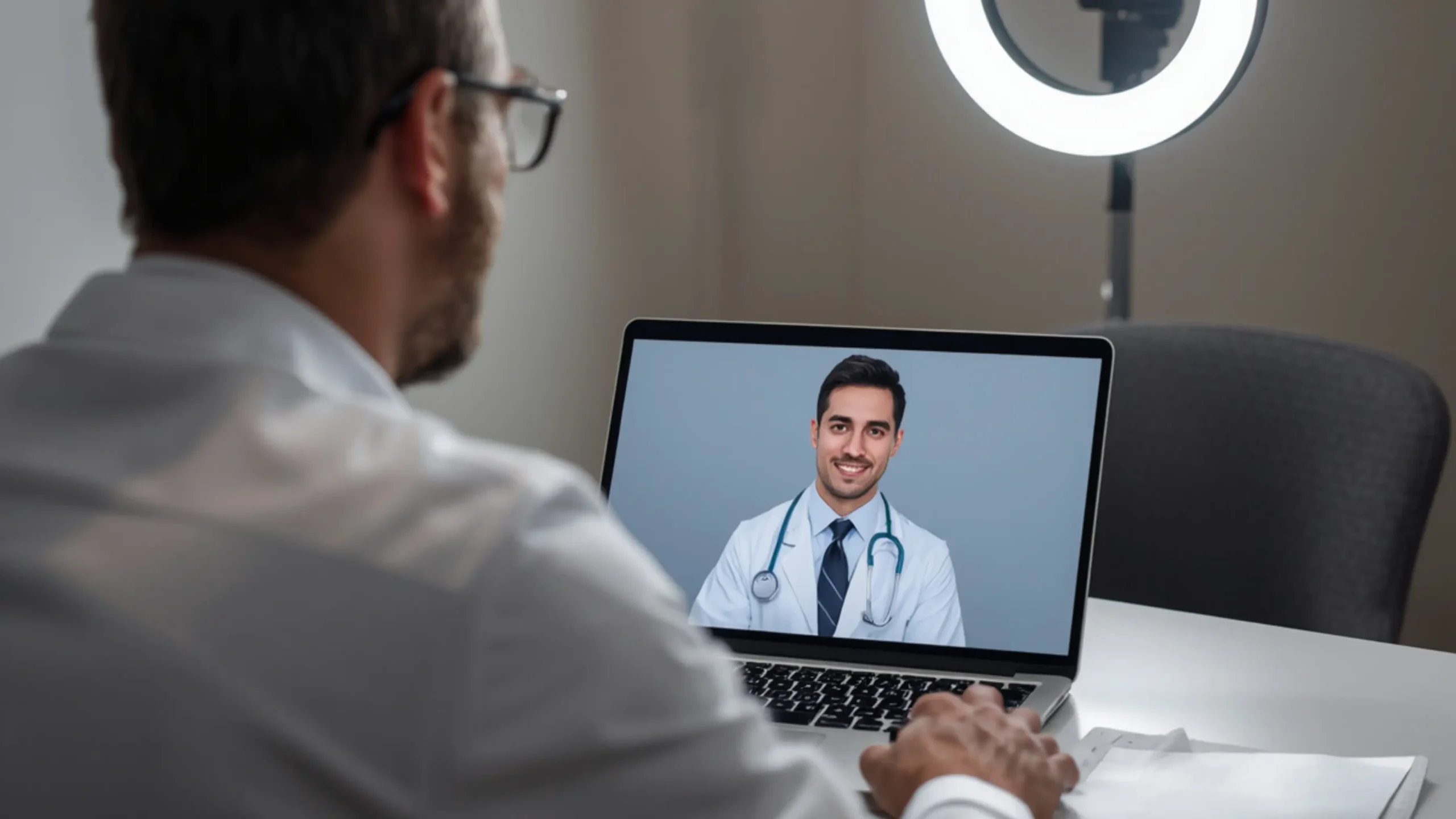
We have watched strong candidates lose offers on the technology side of a video interview. Not on the answers. On the setup.
Most physician interview prep covers what to say. Expect questions about your training, your gaps, your reason for the specialty, your reason for the geography. That preparation matters and is well covered in residency career counseling. What is less covered, and what costs candidates more often than the content does, is the 20 minutes before the call starts.
Here are the five fixes that make the biggest difference, in the order they matter.
Fix 1: Camera at eye level, not below
The default laptop position is on a desk. Your face on screen ends up tilted up. The interviewer is looking up your nose for an hour.
This is the single most common video interview problem and the easiest one to fix. Stack books, a riser, a stack of textbooks from your white coat days, anything that gets the camera lens to within an inch of your eye level. The visual difference between a camera below eye level and a camera at eye level is the difference between looking authoritative and looking exhausted.
For laptop users specifically: you want to be looking slightly up at the camera, not down. Slightly up reads as engaged. Down reads as disengaged.
Fix 2: Wired internet, not wifi
Wifi drops at exactly the wrong moment. When the practice administrator asks you to walk through your training, the connection goes choppy, you cut out for three seconds, and the moment is broken.
If your residency or current home setup has an ethernet port available, use it. Buy a $15 ethernet cable. Plug in. The signal is more reliable, the bandwidth is more consistent, and you eliminate the variable that hits roughly 40% of the candidates we coach through interview prep.
If wired is not available, two backup steps. First, restart your router 20 minutes before the call so it has fresh memory. Second, if you live with anyone, make sure they are not running large downloads or video streams during the interview window.
Fix 3: Light source in front of you, never behind
A window behind you means the camera sees a silhouette. Your face is in shadow. The interviewer cannot read your expressions.
The fix: rotate your setup so the brightest light source in the room is in front of you, not behind. If that means turning your desk 90 degrees for the interview, do it. Natural light from a window facing you is ideal. A ring light works if natural light is not available. A single overhead light by itself will produce shadows under your eyes and make you look tired.
The test: 30 minutes before the interview, turn on your video and look at the preview. If your face is darker than the wall behind you, your lighting is wrong.
Fix 4: Full professional dress, head to toe
You will stand up at some point during the call. The doorbell will ring. You will need to grab a notebook. The interviewer will get a glimpse of athletic shorts under the dress shirt.
Dress as if you are walking into the practice in person. Full professional, head to toe. Closed-toe shoes. The shoes matter even when no one can see them, because your posture changes when you are dressed completely versus partially. Candidates who half-dress for video interviews show up differently than candidates who fully dress.
A specific note for hospital-employed physician interviews: the practice administrator and the medical director may join the call from the hospital, in their work attire. You should match their level of dress, not what you would wear to clinic.
Fix 5: Two specific questions about their program, prepared in advance
Most candidates reach the end of the interview, get asked “do you have any questions for us?”, and produce something generic. “What is the work-life balance like?” Or “What are the team dynamics?”
These questions reveal that the candidate has not researched the program. They are also the questions where the practice administrator’s eyes glaze over.
Walk in with two specific questions about their program. Not their specialty in general. Their specific program. Examples:
For a hospital position: “I noticed your hospitalist team has expanded by 30% in the last two years. What is driving the growth and how is it changing the case mix on the floor?”
For an outpatient practice: “Your patient panel mix appears to be 60% Medicare. How does that affect your scheduling structure compared to a more commercial-heavy practice?”
For an academic position: “Your residency program in this specialty matches in the top quartile. What part of the curriculum is the program most focused on developing right now?”
These questions accomplish three things. They demonstrate you researched the program. They give the interviewer a chance to talk about something they care about. They generate information that helps you actually evaluate whether the role is a fit.
The research takes 30 minutes on the practice website, the LinkedIn profiles of the team you are meeting, and any recent news coverage of the system.
A few smaller things that add up
A few additional items, each smaller individually but worth the prep time:
Test the platform. If the interview is on Zoom, log in 15 minutes early to confirm your account works. If it is on Microsoft Teams, the same. If it is on the practice’s proprietary system, do the test call the day before.
Headphones, not laptop speakers. Echo and feedback are eliminated. The interviewer’s voice comes through clearer.
Mute notifications. Slack, email, calendar reminders, text messages. Mute everything for the duration of the call.
Have a glass of water within reach. Not a coffee mug. Coffee mugs photograph as branded objects (the Starbucks logo, the residency program mug). Plain glass of water is neutral.
Print the names and roles of everyone on the call. You should not be checking their LinkedIn during the interview. You should know their names already.
Position your notes on the wall behind your camera, not on your screen. Eye contact stays with the camera, not with a sidebar of notes.
What we tell candidates the day of
Three things, in this order:
The setup is what makes the content land. You are not going to outperform a poorly-lit, choppy video interview with a great answer. You will outperform a well-lit, stable video interview with a great answer. The setup is the foundation.
The interviewer wants you to do well. The practice administrator and the medical director are not trying to trip you up. They are trying to figure out if you fit. Treat them as collaborators in that question, not as adversaries.
After the interview, send a thank-you note within four hours. Email. Specific. Reference one thing each interviewer said that you found compelling. The candidates who follow through after the interview close at higher rates than the ones who do not.
The recruiters at MedSource Consultants have walked physicians through video interviews for every major hospital system and physician group in the country. Happy to do a 20-minute prep call before yours.
For a confidential conversation: 800.575.2880.